
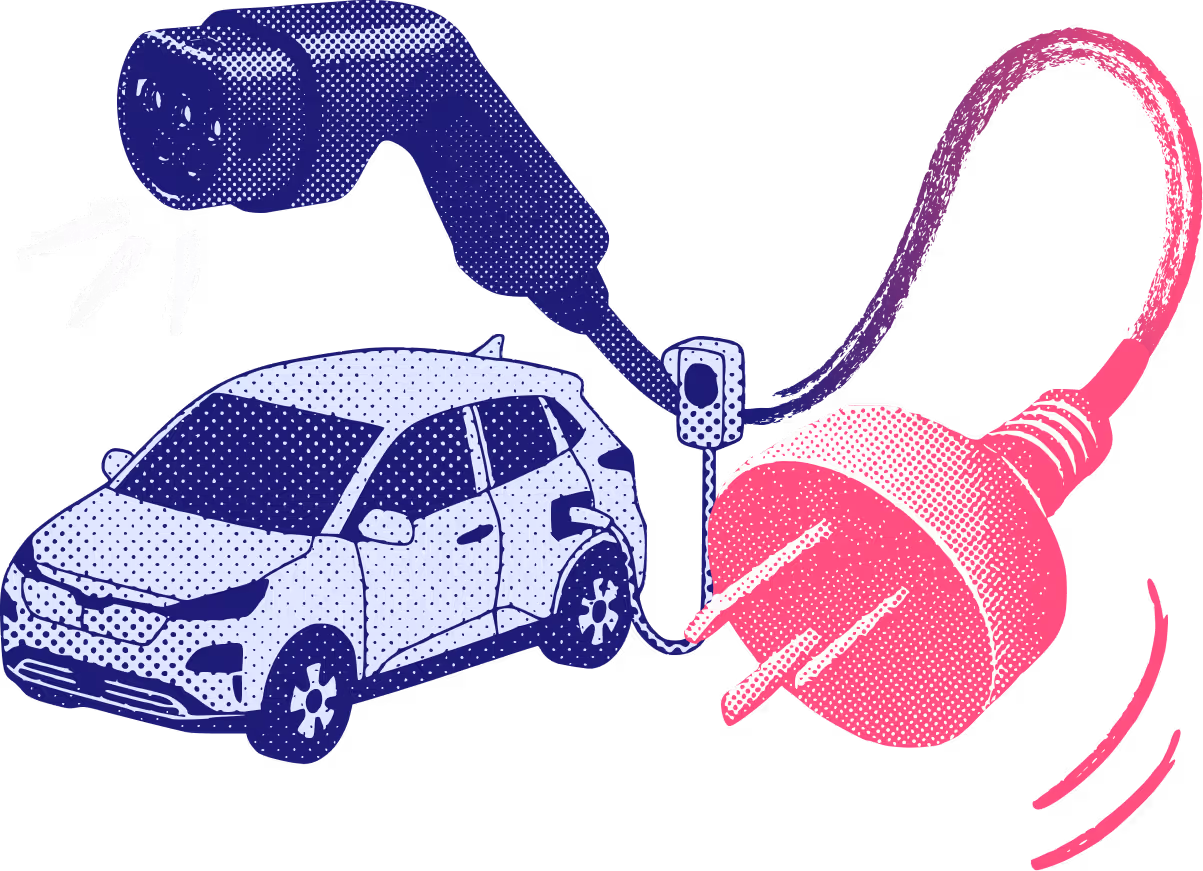
A Step-by-Step Guide for your fleet
Switching to electric vehicles isn’t just good for the planet, it’s smart for business, with lower running and maintenance costs, reduced emissions, and a future-ready brand.
Get on your way

1. Assess your current fleet
Create an inventory of your vehicles: Type, age, usage patterns and fuel costs. Identify high-usage vehicles or those due for replacement soon. Consider vehicle duty cycles: daily distance, load, terrain, and idle time.
2. Evaluate EV suitability
Research available EV models, compare key features like range and charging speed, and assess total cost of ownership. Talk to suppliers about pricing and incentives, and learn from other businesses and EV user groups to gain practical insights.
3. Team Engagement
Involve your team early in the EV transition. Address concerns, highlight benefits, and ensure staff feel supported, especially if vehicles are part of their daily work or benefits. A well-informed, engaged team helps make the shift smoother and more successful.
4. Pick Your EV Fleet
Evaluate available models based on range, charging speed, and total cost of ownership. Engage suppliers for pricing and incentives, and learn from other businesses to find EVs that best suit your operational needs.
5. Plan charging infrastructure
Where will vehicles charge? e.g. at a depot, at the place of work, at home What charging speed is needed? Consider the electrical capacity at the charging site. Consider smart charging to manage load and costs.

6. Build the business case
This should include: capital costs and charging costs vs. fuel and maintenance savings, emissions reductions, staff and customer engagement benefits.
7. Financing
Assess the total cost of ownership, including fuel and maintenance savings, charger installation, and financing options like green loans. Review internal budgets and consider whether owning or leasing EVs best suits your business’s financial structure.
.avif)
8. Secure Your EVs
Choose the best procurement approach, buying or leasing, based on your business’s financial strategy. Finalise vehicle selection, confirm pricing and incentives with suppliers, and plan for any required infrastructure like chargers.
9. Education and training
Equip drivers and fleet managers with practical EV knowledge, covering vehicle operation, charging, range planning, and troubleshooting. Well-trained staff ensure safe, confident use and help maximise the benefits of your EV fleet.
10. Monitor and scale
Evaluate energy use, cost savings, vehicle performance. Use this data to inform wider rollout.

Ready to explore EVs for your business?
Whether you're just starting to explore your options or ready to take action, the Queenstown Electrification Accelerator offers trusted, independent advice to help you move forward with confidence - get in touch.
Example EVs
Last updated Dec 2025
Vehicle Name
Body type
Used or new
Range
Price
BYD Atto 3
BYD Dolphin
Farizon EV
Ford E-Transit
Geely EX5
Geely Riddara RD6
GWM Ora
Hyundai Ioniq 2017
Hyundai Ioniq 5
Hyundai Kona EV
Kia EV5 Light
Kia EV9 Light (7-seater)
LDV eDeliver 3
MGS5
Mini Cooper E
Nissan Ariya
Nissan Leaf 2015 24 kWh
Nissan Leaf 2018 40 kWh
OMODA E5
Peugeot e-Expert
Polestar 2 2022
Skoda Enyaq 85 Sportline
Tesla Model 3
Tesla Model 3
Tesla Model Y
Toyota Bz4X Pure
Volvo EX30 Single

EVs are key to lowering operating costs
EVs use cheaper energy.
Charging an EV at home at off peak electricity rates costs the equivalent of about $1.60 a litre, including road user charges.
EVs also use their energy more efficiently.
In a petrol or diesel car, around 90% of the energy in the fuel is lost as heat and noise, only about a quarter actually moves the vehicle. An EV typically only loses around 20%, and some of that is recovered through regenerative braking.
EVs are cheaper to maintain.
Each EV can save you hundreds of dollars a year in maintenance and service fees. This is because they have fewer moving parts, no oil to change, no exhaust system, and no clutch or spark plugs to replace.
Frequently Asked Questions
Range & functionality
How far can an EV go?


The average Kiwi drives 200km per week. Most new EVs have 300-500+km of range, and many second-hand models offer 200-350km (although this varies depending on the type of driving and conditions). Even affordable older Leafs with under 100km range suit daily commutes, and the gap between charging stations is approximately 75km on most state highways.
If range keeps improving as it has over the years, we may not even need to stop to charge on that 800 km trip, although we have never seen a human bladder last that long.
How do you charge?
Most EV owners (80%) charge at home [6], typically overnight with a standard three-point plug [7]. Installing a dedicated EV charger at home means you can charge faster, but is not necessary, especially when the average car in NZ drives just over 200 km in a week; one overnight "trickle charge" through a normal power point can get you around half of this. This also means you can make most of time of use plans like free hours or off peak rates.
Public chargers are still important for longer trips and those without off street parking. Medium-speed chargers can be great for 1 hour stops at libraries, the gym, etc. On road trips, a 150kW fast charger can add 300km of range in about 20-30 minutes, perfect for a lunch stop.
Can EVs tow or do 4WD?
Many AWD EVs handle dirt roads and ski fields easily, and many have tow ratings suitable for trailers, but maybe not a big boat. EVs designed for specifically for 4WDing have superior performance to fossil fuel 4WDs, but these expensive new models like the Ford F 150 Lightning, Mercedes Benz EQB, and Rivian R1 may not be widely available in NZ yet.
Check out evdb’s full list on towing weights: evdb.nz/l/tow
Towing does reduce range, but by how much depends on the weight and whether the car has been designed to tow. One test by the EV Drivers Association showed an Audi e tron decreased its range by 1/3, while a Tesla Model S reduced its range by 1/2, when towing a caravan [1]. Most EVs in New Zealand today are not designed for towing significant amounts, though this is expected to change. Models overseas like the Chevy EV are emerging demonstrating that EVs can tow large loads over long distances.
Safety, technology, & environment
What about battery life?
Modern EV batteries last a long time. Battery degradation is an issue with some earlier EVs and the replacement costs are high. But modern EV batteries are guaranteed for many years and show very small amounts of degradation. EECA says most new EVs have battery warranties that guarantee the battery for around 8 to 10 years or a distance of 160,000 km [4], which is similar to 5 to 6 years of average driving. Even after that, as with older second hand EVs, their ranges are likely more than capable of doing most everyday commutes, at significantly lower upfront and running costs.
How likely is an EV to catch fire?
Data from 2010–2022 suggests that internal combustion engine (ICE) vehicles have an almost 100 times higher chance of fire than a passenger EV.
EV Firesafe, an Australian company funded by their Department of Defence and one of the leaders in fire tests for first responders, has recorded 772 battery fires globally among 40 million EVs since 2010. Their initial research findings, measured based on global EV battery fires from 2010 2022, find a 0.001 per cent rate of a passenger electric vehicle battery catching fire. While it is difficult to find a comparison rate for ICE passenger vehicles globally, a range of country based reports we found suggest there is a 0.1 percent chance of an ICE vehicle catching fire [5].
Are they really better for the climate?
Yes, even including manufacturing and charging. In New Zealand's renewable-heavy grid, EVs produce far fewer emissions over their lifetime. Learn more: bit.ly/ev-carbon
Cost & convenience
Are EVs cheaper overall?
Some EVs have higher upfront costs, but prices are dropping and the lifetime cost is much less. Add low-interest finance, and you can save money from day one.
If you’re in the market for a car today, one of the main barriers might be the upfront cost, where most EVs are still more expensive than their internal combustion engine (ICE) counterparts. However, the upfront cost difference between EVs and ICEs is also coming down and projected to reach parity soon. There are also many secondhand EVs available at much lower prices. If you have access to low-interest long-term finance, the repayments (including interest) could be cheaper than the petrol bills you’re paying right now [8].
When you add on the operating costs of owning a vehicle, EVs come out on top. With petrol and diesel cars, you’re locking yourself into a multi-year fuel and emissions subscription that costs $100s-$1000s per year and is projected to keep increasing. For people who drive a lot, such as those living rurally or driving for work, this means the savings from going electric are even greater.
What about maintenance costs?
A study by the German Automobile Club found EVs averaged 3.8 breakdowns per 1,000 vehicles, while similarly aged combustion models more than doubled that rate [2]. Since EVs have no oil to replace and fewer moving parts, they have lower maintenance and repair costs [3].Earlier EVs did not last as long as petrol and diesel vehicles, but due to advances in technology, they now have similar lifespans of around 13 years with higher resale value. EV and EV batteries are now often outlasting the cars they are powering [4].
Can you save money with EVs, even without solar panels?
Even powering an EV via grid electricity is much cheaper than petrol or diesel. Including road user charges, charging your EV with your own solar is the equivalent of around $1.16 per litre, but charging from the grid is still only $1.51 per litre, much cheaper than petrol at around $2.77 per litre [9]. This outweighs any upfront cost difference that the EV might have in comparison to petrol vehicles, over the lifetime of the vehicle, making it the more economical choice for the average NZ driver. Fast charging is much more expensive, but still cheaper than petrol in most cases.
What about hybrids?
Hybrids still burn 50-70% of the fuel of petrol vehicles and cost more to maintain than EVs. For most drivers, going full EV makes more financial and environmental sense.
References
[1] https://cleantechnica.com/2021/01/18/caravan-trailer-on-the-tow-hitch how-it-affects-ev-range/
[2] https://thedriven.io/2025/04/14/evs-more-reliable-than-ice-vehicles-with-the-best-and-worst-electric-cars-identified/
[3] Burnham, A., Gohlke, D., Rush, L., Stephens, T., Zhou, Y., Delucchi, M. A., ... and Boloor, M. (2021). Comprehensive total cost of ownership quantification for vehicles with different size classes and powertrains (No. ANL/ESD–21/4). Argonne National Laboratory, United States.
[4] Nguyen-Tien, V., Zhang, C., Strobl, E., and Elliott, R. J. (2025). The closing longevity gap between battery electric vehicles and internal combustion vehicles in Great Britain. Nature Energy, 10(3), 354–364.
[5] https://www.evfiresafe.com/ev-fire-faqs
[6] https://www.consumer.org.nz/articles/new-zealand-electric-car-myths-debunked
[7] https://www.powerswitch.org.nz/the-best-power-plans-for-charging-your-ev
[8] https://www.rewiring.nz/watt-now/show-me-the-money-electric-economics
[9] This assumes road user charges of $76 per 1000 km, average petrol efficiency 8.72 L/100 km, 1:4 petrol to electric motor efficiency ratio, petrol fuel density 9.5 kWh/L, grid price $0.27/kWh, financed solar price $0.12/kWh, petrol price without excise $1.90/L.
[10] https://www.rewiring.nz/watt-now/why-going-electric-wins-on-emissions
[11] https://countiesenergy.co.nz/media-centre/counties-energy-repurposes-end-of-life-ev-batteries-to-recharge-new-ev-cars/
[12] https://www.canarymedia.com/articles/energy-storage/redwood-used-batteries-data-center
[13] Zhang, J., and Azimi, G. (2022). Recycling of lithium, cobalt, nickel, and manganese from end-of-life lithium-ion battery of an electric vehicle using supercritical carbon dioxide. Resources, Conservation and Recycling, 187, 106628.
[14] Daan Walter, Will Atkinson, Sudeshna Mohanty, Kingsmill Bond, Chiara Gulli, Amory Lovins (2024). The Battery Mineral Loop: The path from extraction to circularity. Rocky Mountain Institute (RMI).
[15] Energy Transitions Commission (2023). Material and Resource Requirements for the Energy Transition.
[16] https://www.rewiring.nz/watt-now/closing-the-loop
Discover more resources
Household EV Guide
A step-by-step guide on everything you need to know before getting your first EV at home

Solar Step by Step Guide
Your easy roadmap to choosing the right solar setup for your home and budget.
-3.avif)
Solar Financing Guide
A clear breakdown of ways to pay for solar, from loans to grants, so you can pick what fits your situation.